Why Students Choke under Examiner (And What to do to avoid it)
I. Introduction
You’ve been there.
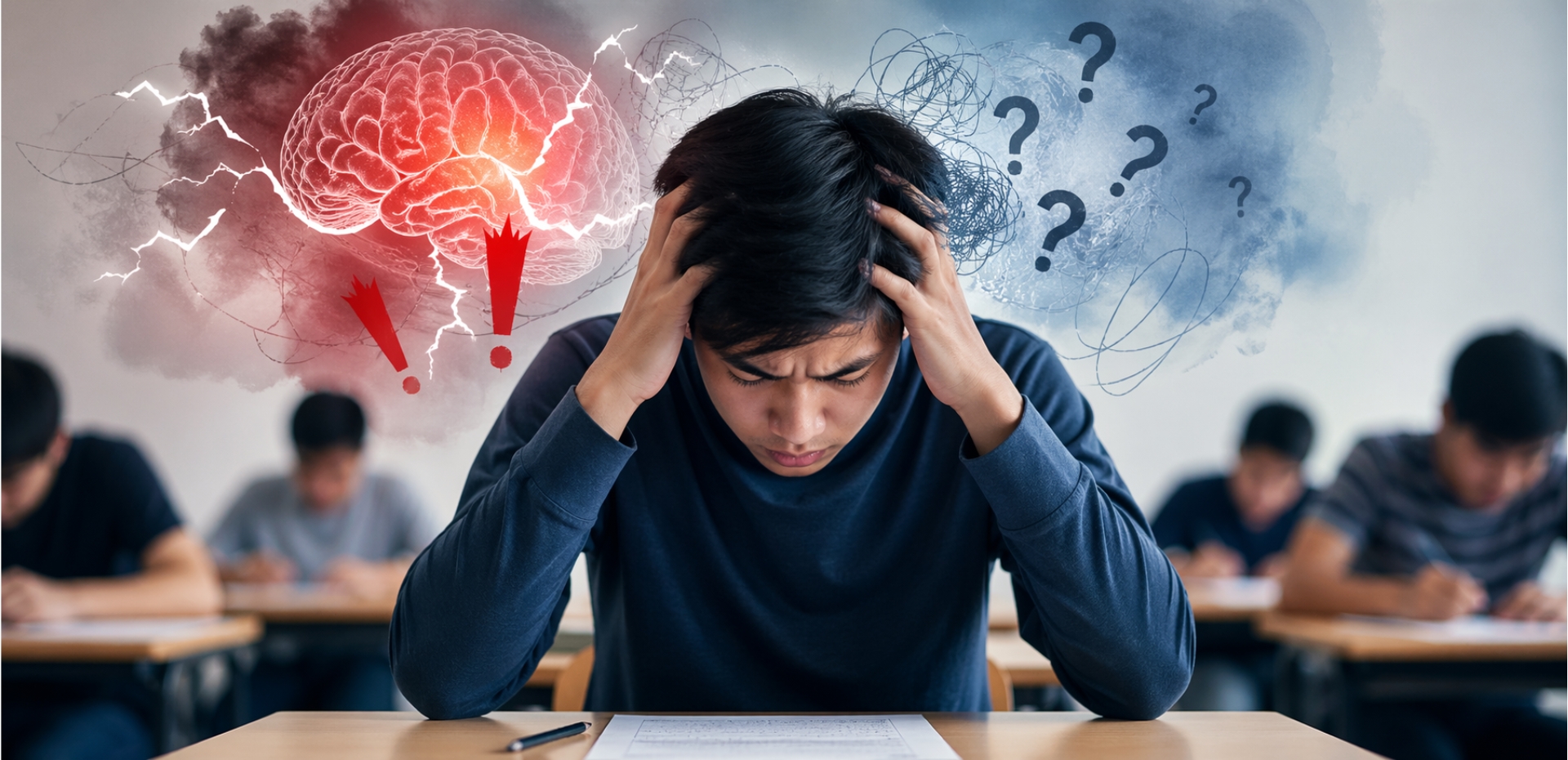
The test document comes in your face. You revised weeks and weeks. Flashcards, notes, past papers–you got it all correct. And then, when you get the question the first. nothing.
Your thoughts spin round and round.
This is precisely what happens to students, and test anxiety, a frustrating, nearly surreal condition of freezing in exams. It’s not laziness. It is not stupidity. It is your brain that goes off like a panic button at the worst time.
The good news? This is entirely a natural reaction–and more so, manageable. Seeing how the science of blanking out when taking a test works, you can learn to beat test anxiety with real-world, time-tested techniques.
II. The Science of Freezing
The Fight, Flight or Freeze Response
When you sit an exam with a high stakes, it is not necessarily perceived as a test that is not threatening to your brain. Alternatively, it can perceive it as a threat.
This is in the form of the fight or flight response in exams- a survival mechanism that helps keep you out of harm. Your heart rate rises, your breathing rises and your body is ready to respond.
And there is a hitch. This reaction is very helpful in actual peril, but horrible when it comes to critical thinking. The brain diverts resources to logic and reasoning, causing it to be more difficult to concentrate, process and retrieve information.
Hippocampus and cortisol
This is where the fun begins.
Whenever it is triggered by stress, your body combusts cortisol, a hormone that overflows your system. It can be used in small doses to sharpen alertness. But in excess? It prevents entry to your memory.
Particularly, cortisol comes in the way of the hippocampus- the section of your brain that retrieves stored information.
And though you know that, your brain frees you not now. That is why students have a blanking out experience on a test–the information is available, ant the knowledge is blocked away.
III. Ordinary Examinations That cause Exam Anxiety
Finding out what causes students to freeze at exams also implies knowing about their triggers.
High expectations & fear of failure
Exams can become life and death situations due to pressure by parents, teachers and even by yourself. Such pressure contributes to anxiety.
Inadequate preparation
It may appear effective at cramming but cramming undermines the retrieval of memories. And without regular practice, your brain chokes in the pressure.
Past negative experiences
An unfavorable outcome may be mentally scarring. The brain recalls the stress and waits that it will occur once again.
Perfectionism
Desiring the ideal solution can even freeze you. Panic sets in when it does not arrive in an overnight fashion.
IV. Preventing Freezing Before the Exam
The most appropriate defence against test stress begins much before the test date.
Active Renewal and Delays Repetition
Notes reading is not sufficient. You must put yourself to the test.
Active recall (such as flashcards or practice questions) helps reinforce memory pathways. Combine it with spaced repetition and your brain improves in recalling information when under pressure.
Simulate Exam Conditions
Don’t be taken by the actual exam.
Practice in silence. Set a timer. Remove distractions.
Mimicking exam conditions teaches your brain to remain calm in an exam situation.
Physical Preparation
Your brain is a part of your body–trend it so.
- Sleep: 7-9 hours can aid in memories consolidation.
- Hydration: More concentrated dehydration influences the concentration.
- Nutrition: Balanced food is stable to maintain stability of energy and mood.
These are not just optional but must have study tips to deal with test anxiety.
V. Unfreezing in the Exam
Despite preparation, anxiety can creep in. The following is how to regain control in the moment.
The 4-7-8 Breathing Technique
- Inhale for 4 seconds
- Hold for 7 seconds
- Exhale for 8 seconds
This decelerates your heart rate and is a signal to your body to relax- reversing the fight-or-flight reaction.
Grounding Exercises
Try the 5-4-3-2-1 method:
- 5 things you see
- 4 things you feel
- 3 things you hear
- 2 things you smell
- 1 thing you taste
This takes your mind off panic and brings it back to now.
Skip and Return
Baffled with an inquiry? Don’t fight it.
Skip it. Move on. Warm up with less challenging questions. You will find that so often the answer will return as your brain is no longer tense.
Brain Dumping
Jot down important formulas, concepts or key words at the beginning of the examination.
This will release mental space, as well as put less pressure on your working memory.
VI. What Teachers and Parents can do
It is not the students who anxiously watch exams.
Reward hard work and not results
Give attention to the work but not the grade. This helps promote confidence and eliminate fear.
Open communication
Develop a non-judging atmosphere so that students can discuss stress.
In some cases, just the very act of being listened to can be more calming than a form.
VII. Conclusion
It is natural to freeze in tests and it is not an indication of failure. When you find out the reason why students freeze when there is an exam, then you can begin to get control of this.
Test anxiety is workable, not feel-the-heat, with the proper combination of strategies to know how to prepare and the methods to use in the mind and the encouragement to get the test finished.
And remember this:
A single exam is not enough to determine what you are intelligent at, what your ability is, or what your future is.
Have you ever felt blanking out on a test? Share your story–or read even more tips on how to beat exam anxiety by subscribing to our recent research and mental wellness information.