IGCSE Study Timetable Template: Your A’s Scoring Guide
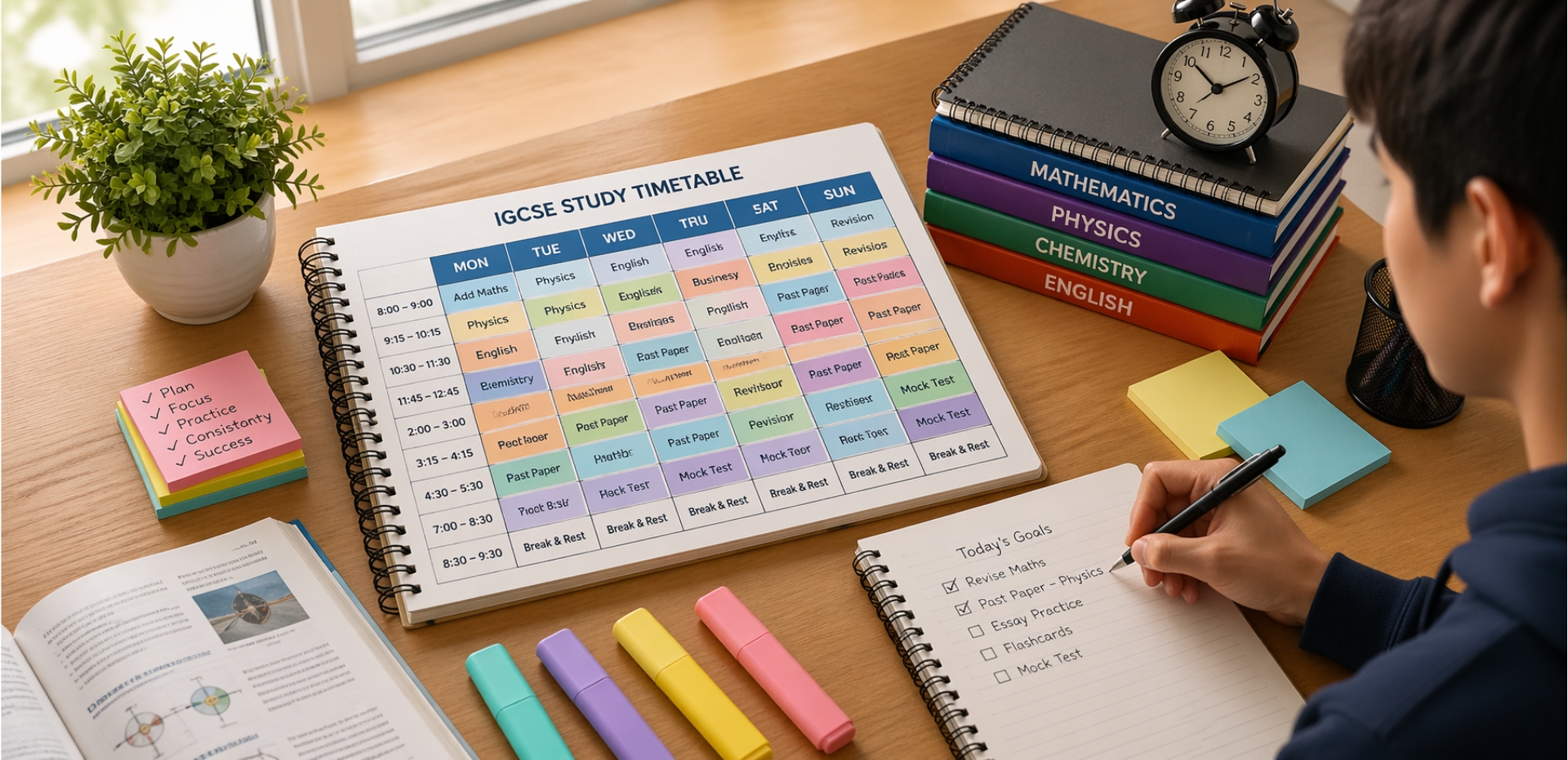
The Cambridge syllabus, the IGCSE is more than just big. Subjects pile up. Papers multiply. You turn around the next moment and revise a formula, then get buried in the case studies and essay structures. No wonder students are overwhelmed.
However, this is where the change is: the key in IGCSE is not to study harder to achieve success. It is regarding learning smarter–with a system.
Through this guide you will understand just how to arrange your revision time, and you will have a template of your own study timetable, ready-made and ready to use, to start your journey to A+.
Why Structured IGCSE Study Plan is Your Secret Weapon
An appropriate schedule is not confining. It’s liberating.
First, it will eliminate burnout. The Cambridge syllabus is mammoth-like, yet when divided into digestible portions per day it becomes by far much less daunting.
Second, it makes sure that there is nothing falling through the cracks. Some of these papers are unknowingly overlooked by many students e.g. the student focuses on one-side of the coin (Paper 4) and fails to prepare the other side (Paper 6). An organised blueprint keeps track of it.
Third, it lowers exam and nerves. Once you get used to your study routine, your mind remains relaxed. You are not wondering what to revise after that you know.
To understand how structure works towards results, check out ORIENT Academy ORIENT Learning Framework a framework which is programmed to transform consistency to the highest grades results.
How to Create the Optimal IGCSE Study Plan (Step-by-Step)
Audit Your Subjects and Syllabuses
Begin by printing out the official Cambridge syllabus of all the subjects. It is not buswork you are doing. You will obviously find topic weightage, key areas and actual aspects of what examiners really desire.
Step 2: Apply the “Traffic Light” System to Weaknesses
Not everything is subjects of equality. There are some that require immediate help.
- Red: You suffer–level (spend 60% of your time)
- Yellow: You know but you must repeat.
- Green: You are sure–fair correction.
Your schedule must not be about strengthening comfort zones, but addressing weaknesses.
Step 3: Have Active Recall and Spaced Repetition
Note reading is not study but exposure.
Instead:
- Flashcards Test yourself by using flashcards.
- Answers to be written without pencil.
- Respond to the same topics at periodic intervals (Day 1, Day 3, Day 7).
This is the long term information sticking.
Step 4: Consider Past Papers and Mock Exams
History can never be compromised.
Schedule 12 sessions a week with time progressively added as exams come nearer. Always write to official mark schemes–this is the way to get to know what the examiners mean.
Step 5: Plan Rest, Hobbies and Sleep
And you cannot work to a timetable when you are tired.
Minimum of 2-4 concentration hours per day, 7-8 hours of sleep and have breaks. Downtime is needed by your brain to consolidate memory.
Sample Weekly IGCSE Revision Weekly Schedule
This is what a typical week of a Year 11 student may consist of:
- Weekdays: 2 hours post school/tuition.
- Weekends: 4- 5 hours with past papers.
Alternate something heavy and light:
- Heavy: Additional Maths, Physics.
- Light: English, Business
For example:
Monday can be dedicated to Add Maths (Red topics) and Physics, and Tuesday will be devoted to English and Business. This rotation will keep your brain active and will not get you tired.
3 Fallacies to Watch Out When Planning Your Studies
Overbooking Your Time
Planning six or more hours a day would be ambitious -but beyond reason. Motivation plummet when you do not adhere to it.
Without Paying Attention to the Mark Scheme
You may have heard what is in it–but have you heard how marks are given? Never forget to prepare based on examiner expectations.
What to Learn about Learning
It is pleasant to write about Green stuff again–but does not get the needle stuck. Development occurs at the “Red” level.
ORIENT Academy in Cyberjaya Offers Expert Guidance
Nobody can resist a timetable–but however, in the presence of guidance, nothing can be stopped.
It is not merely the learning at ORIENT Academy but through our programs OIS and OWS, students participate in a number of structured, individualized systems.
Our history speaks it all. Umair and students like him have been successful in the additional mathematics as Top in the World not by accident but through planning and encouragement.
The small classes and respective learning plans allow each student to receive the desired personal attention to do well.
Summary and Action Plan
A good timetable transforms confusion to clarity. It keeps you in check, on track and on top of the curve.
Unless you are struggling to keep yourself consistent (or not knowing where to begin) you do not need to work it out yourself.
👊 Having difficulty with your preparations to IGCSE? Register a Free Academic Counselling with our experts in Cyberjaya today.
📩 👉 [Schedule a Free Academic Consultation].
It is time to begin your A+ plan.