Should Students Opt for IGCSE Core or Extended?
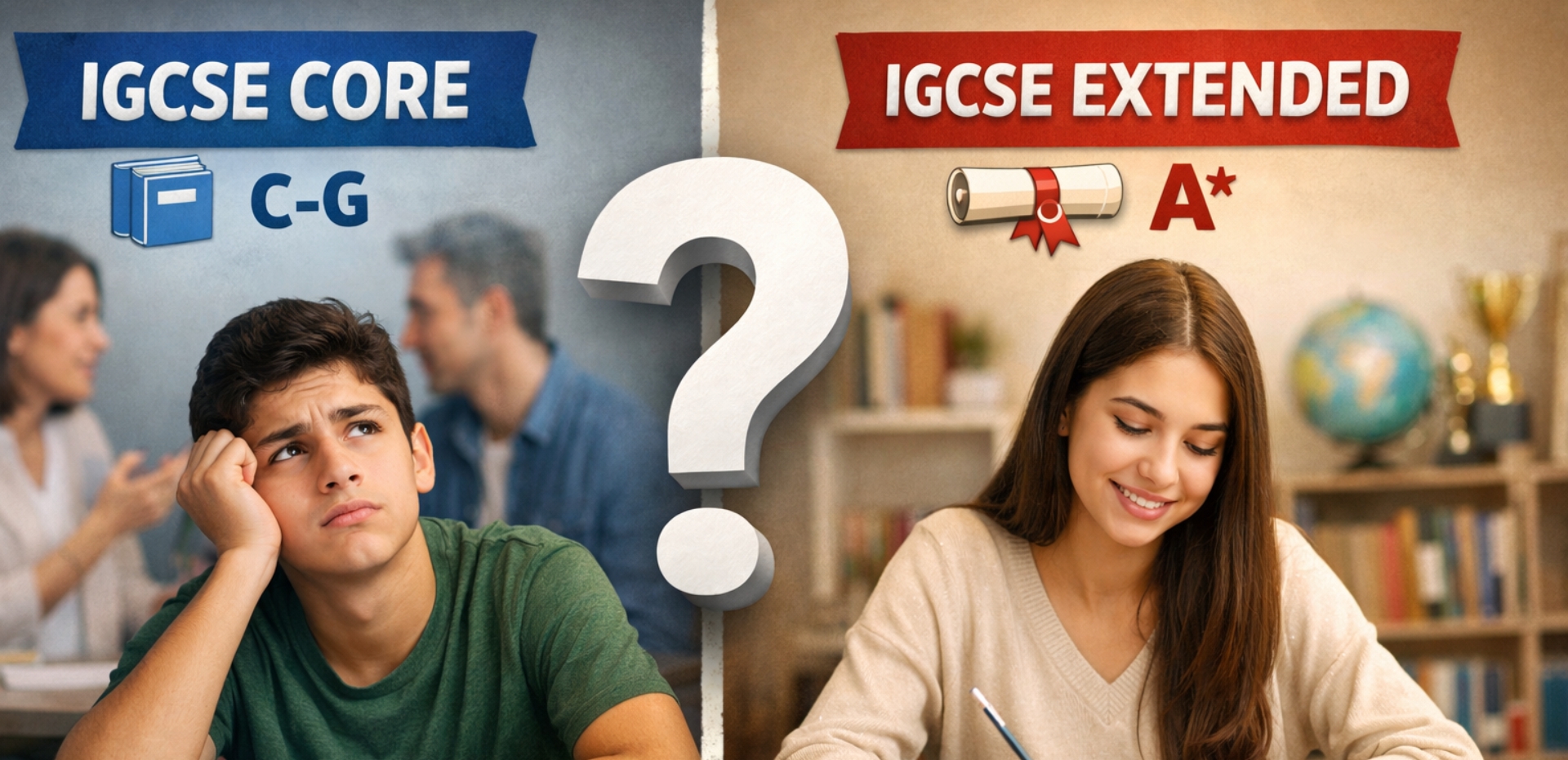
There’s a distinct pressure that arises in a house, when it comes to IGCSEs.
It’s evident in the middle-of-the-night debates. In the double-reading of report cards. In the nagging, elusive question all parents put to themselves (even if they don’t always discuss it with the children themselves):
“Am I making the right decision for my child?”
In the Cambridge International General Certificate of Secondary Education (IGCSE) stream, this crucial decision can often boil down to one: IGCSE Core or Extended.
In subjects such as Mathematics, Sciences, and English, parents and students are given a choice between the Core and Extended syllabuses. Both have varying syllabus content, grade scales and long-term considerations.
Let’s be clear about something that we often don’t tell parents:
There is no “best” choice.
The right fit depends on three factors:
- Your child’s academic level
- Their future aspirations
- Their existing level of facility
Let’s get it right.
How Do You Define the IGCSE Core Curriculum?
The IGCSE Core is all about the basics.
It deals with fundamentals; making sure that you get it right before you move on to application and more complex problem solving.
It’s all about finding the ground floor in order to reach the top.
Grading Scale for Core
- Grading Scale: C to G
- Note, the highest grade is C
So, students cannot achieve an A or A* grade, even if they have done excellent work. That’s always going to be the case.
Who is Core For?
Core is ideal for students who:
- Consider the subject to be volatile
- Want to develop knowledge gradually
- Are not looking to continue the subject to A-Levels or to university
- Desiring a “guaranteed pass”
In many instances, the reason to choose Core is not a lack of ability to do well in Extended, but a choice.
Because sometimes, it makes more sense to get a safe C, rather than waste time (and effort) on a U (Ungraded) in Extended.
The IGCSE Extended Curriculum
We know the basics, but Extended is the whole deal.
In IGCSE Extended you study:
- Everything in Core
- More complex content and application
This level includes more than just knowledge – it’s about analysis, evaluation and analysis.
Grading Scale for Extended
- Grades available: A to E
This provides the opportunity for excellent academic achievement, particularly for competitors.
Who is Extended For?
Extended is ideal for students who:
- Achieve good grades across their assessments
- Understand the key ideas
- Intend to study subjects at A-Level, Pre-U or at University
- Have ambitions for high grades (A-A)
In other words, Extended is for the latter group.
The Difference Between Core and Extended
Here’s a snappy comparison between Core and Extended:
| Feature | Core IGCSE | Extended IGCSE |
| Syllabus Breadth | Core concepts | Core + advanced concepts |
| Maximum grade | C | A* |
| Examination Questions | Simpler questions based on memorisation | Some complex questions requiring multi-step solving skills |
| Further Education | General Further Education routes | A-Levels, STEM, Elite universities |
Is this your choice? In 30 seconds, this table will show you.
4 Aspects to Keep in Mind: Core vs Extended
1. Academic History
Don’t blindly assume.
Look at:
- School tests
- Mock exam results
- Teacher feedback
If your child is consistently scoring:
- Higher marks → Extended is feasible
- Low marks → Core might be better
Consistency is key.
2. The Career Path
This is where parents tend to make mistakes.
If you child wants to study:
- Engineering
- Medicine
- Data Science
- STEM-related fields
Then Extended Mathematics and Sciences are required.
But if they are strong in:
- Business
- Arts
- Communication
Then Core in weak subjects can be your greatest strength.
3. Student Well-being & Stress Levels
Here’s the trick no bar graph will show you:
Stress is the deadlier enemy of performance.
Being Extended across subjects can be too much for students.
The better approach is:
- Extended for strong subjects
- Core for weaker ones
This takes stress off the table, allowing students:
- Stay motivated
- Avoid failure risk
- Perform consistently
Since a well student will always be better than a tired one.
4. Teacher Recommendations
Teachers see what parents don’t:
- Classroom performance
- Learning patterns
- Exam readiness
They are the professionals.
If a teacher advises Core, it’s not down, it’s up.
Trust the professionals. Then double-check with a back-up plan, if necessary.
Can a Student Go from Core to Extended?
This is a common question we receive.
The simple answer is: Yes, but it must be done at the right time.
When Switching is Possible
Students can usually switch:
- In late Year 9
- Early Year 10
- During bridging programmes
When It Becomes Difficult
It’s not wise to change programs late (for example in Year 11) because:
- Extended has more content
- There is a lot to catch up on
- Pressure increases dramatically
The sooner the better.
Study with Orient Academy to Excel in Both Tiers
Decide to go for IGCSE Core vs Extended.
Acquiring the good grades is another.
And this is where that particular take on IGCSE tuition in Cyberjaya makes the difference.
Personalised Learning, Personalised Results
Students at Orient Academy are not carbon copies.
With:
- Small class sizes
- Small group sizes
Every student gets:
- Individual attention
- Academic direction
- Tier-specific strategies
We don’t make assumptions about which tier class a student should be in (Core or Extended), we do the math.
Pre-testing & Post-testing Approach
Before we recommend which tier your child should study, we:
- Current knowledge level
- Concept gaps
- Exam readiness
Pre-testing will tell us where your child is now.
Post-testing reveals:
- Improvement
- Readiness for Extended
- Or need for Core
It’s structured. It’s measurable. And it works.
Proven Results That Matter
We’ve seen it time and time again:
- Students from E to B
- Students moving from Core to Extended with ease
- Students earning an A in difficult subjects
Because success has little to do with ability.
Conclusion
Let’s dispel any myths:
Core is not “worse”. Extended is not “better.”
They are just different options for different people.
The real mistake?
Deciding to choose based on appearance rather than strategy.
Make the Best of It!
Don’t guess whether your child should take IGCSE Core or Extended.
👉 Request a Free Academic Assessment with Orient Academy, Cyberjaya
Get:
- Expert subject assessment
- Subject tier recommendation
- Study plan tailored to your child
So you can help your child get the success they deserve.