When Should Students Start Preparing for IGCSE?

Every parent hits, usually sometime between Year 7 and Year 9, when you feel that IGCSE is very heavy. There’s a blurrier trajectory of time where you expect expectations. And, suddenly the question becomes urgent: Is too late?
(Let’s cut through the noise.)
Cambridge IGCSE isn’t just another exam; it’s a globally recognised qualification that shapes academic direction, confidence and future pathways. And here’s one very basic truth people do not recognize: That success isn’t starting too late; it’s starting ‘right’.
Understanding the Standard IGCSE Timeline
The Cambridge Pathway is built like a slow build, not a sprint.
In Years 10 and 11, students will usually move in via the official IGCSE programme from Lower Secondary (years 7 through 9). This two-year period is when real exam preparation take place (i.e., core Cambridge IGCSE subjects, such as English, Mathematics and Sciences) plus elections.
It just might have been an engineered system which has been built for progression. All these stages set the next stage.
The Ideal Preparation Timeline: Phase by Phase
Years 7 to 8 (Ages 11–13): The Foundation Phase
That is how strong students are quietly constructed.
No pressure. No past papers. Just fundamentals
At this stage, we want students to master core skills: English understanding, mathematical logic and scientific thinking. What’s more, students start learning habits: how to concentrate, how to ask questions, how to learn independently.
A solid foundation here makes preparation of the IGCSE exams later appear natural, not overwhelming.
Year 9 (Age 13–14): The Exploration & Subject Selection Phase
If there is a golden window for IGCSE preparation- now and then to start, this is it.
Year 9 is where direction meets decision.
When students start to explore and test their strengths in IGCSE they also start their exploration of the subjects. It is a ideal time to introduce IGCSE-style questions, with their focus on applied application (and therefore in general the information they need in their learning) without having them come so hand in hand with the rote learning process.
This phase is the one on which confidence starts to be formed. Choosing wisely doesn’t change and it’s the next two years very smooth.
Years 10 and 11 (Ages 14–16): The Core IGCSE Program
This is where preparation is performance.
Year 10. Preparation for IGCSE is all about depth. Students learn the syllabus, understand marking regimes and build consistency through topical revision. For it is less memorising this, and more just understanding how answers are evaluated.
In Year 11, the shift is apparent: exam mode.
Past papers prevail. Mock exams recreate pressure. Time management becomes the art of being creative and not an added burden. Grades get honed, and A*s are earned.
This is the study.
Is It Ever “Too Late” or “Too Early” to Start?
Early on, before Year 9, a good start can lessen the pressure going forward. But too much pressure and too soon is a sign of burnout.
And fast-tracking is possible.
With great guidance, motivated and supervised students in a structured IGCSE homeschool setup can shorten the timetable into one year or even six months. Bridging programmes like at Orient Academy are appropriate for this: closing gaps, accelerating preparedness so that people can quickly move up to the Cambridge standard.
In that way, we always have it with a full record in the event where we have a great deal more knowledge here: we are looking for solutions for the future.
4 Signs Your Child is Ready for IGCSE Preparation
Not every student follows the same clock. But readiness does leave clues, and a robust background in Math and English.
• The capability to study from an independent point of view (even in short bursts).
• Appreciation for these subjects or what they are about, interested in going for a career.
• Learning knowledge of concepts rather than memorizing.
If these boxes are alive and well, it is time to lean in.
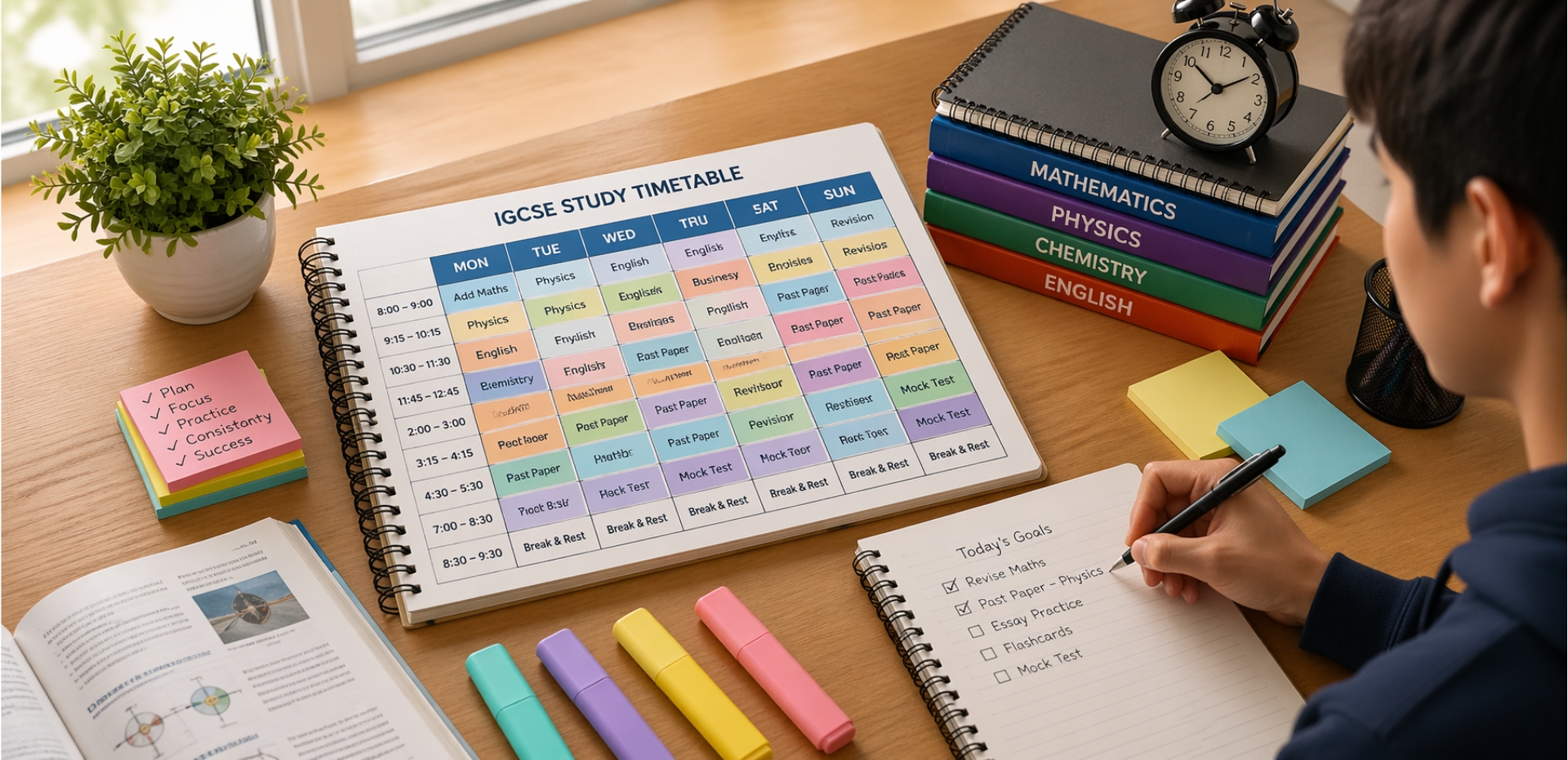
Top Tips for Structuring an Effective IGCSE Study Plan
And forget cramming last minute. It seldom works here.
Instead, establish consistency and a proper “IGCSE study timeline”, to which every other study can be a contribution
- Regular topical revision (weekly, not seasonal).
• A sampling in previous year papers and not just before exams.
- Analyzing Cambridge examiner reports to notice common mistakes.
- Balance academics and downtime, burnout kills performance
Discipline wins. But the bottom line does not end with sustainability.
From this section:
How Orient Academy Can Fast-Track Your Success
In Orient Academy your plan is pretty straightforward: there’s no one-size-fits-all timeline at your disposal.
As part of some structured pathways, for example the Bridging Series (OBS) and Integrated Series (OIS), students are trained down to exam preparation precisely to prepare for the pathway, from the top down. Small class size, specialisation in subject specialist programs, and individualised pacing allows each student to learn at his/her speed, not just that it is normal (as the normal system, or the typical student tends to learn; it is just the speed, even better).
Because your child is building from scratch or speeding forward towards exams, the system adapts to them, not the other way around.
Frequently Asked Questions (FAQs)
Can a student complete the IGCSE syllabus in one year?
Yes, especially for mature, disciplined students. Fast track routes can be reached by investing wisely and with a plan.
How many hours a week should an IGCSE student study?
Early in the programme, about 1-1.5 hours per subject per week works well. As students get into the exam season, it may go up to 4–6 hours depending on the subject, and the student pace.
When do IGCSE exams take place?
There are two main exam series in each year: May/June and October/November.
Final Word: Timing Isn’t Everything, Strategy Is
So to start preparation for to get it right at IGCSE now.
Officially, either year 9 (or 10). Strategically, much earlier.
Because exceltive students don’t just begin first. They build right then do so well, choose smart methods and prepare properly.
Don´t believe your child is ready? contact Orient Academy for a more person-oriented academic consultation or placement test, and map out a timeline that’s actually realistic.