IGCSE Subject Selection Guide for Parents: What to Take, Drop, or Avoid
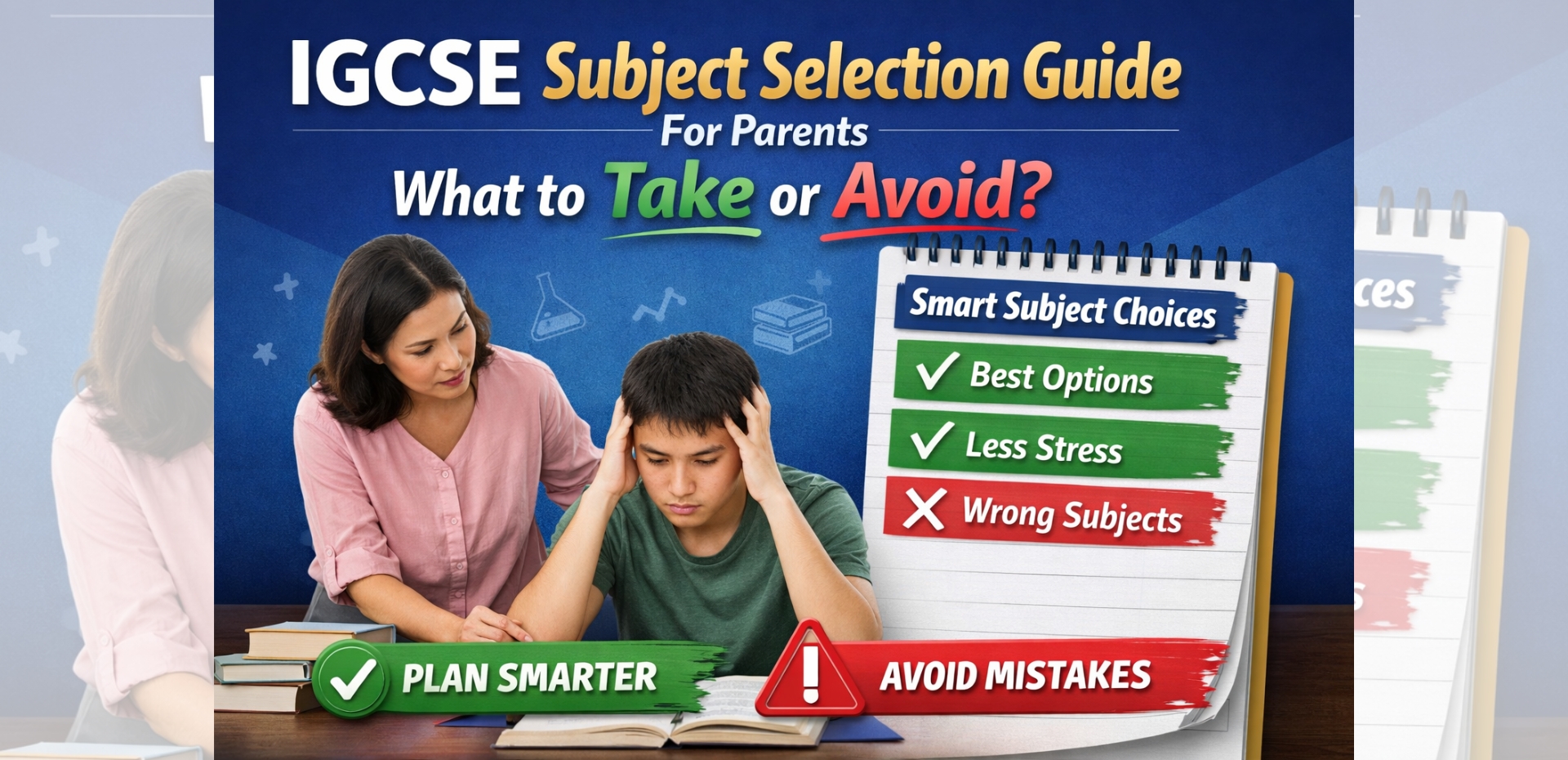
Choosing the right subjects to study for the IGCSE can be a tough decision to make, practically one of the more stressful things to do, considered not as tough as the examination itself.
There are many subjects to fit in that many parents are concerned about whether their children have made the wrong decision by choosing the wrong subjects, whether their children are going to be rejected by universities, or even whether more subjects should be taken as a safe option.
It is a fact that:
👉 Choosing the wrong combination of subjects can be a cause for a lot of unnecessary stress.
👉 Choosing the right combination can make students feel more confident as well as perform better in the subjects.
This guide will look at the more rational ways of choosing IGCSE subjects rather than the emotional ways.
Step 1: Understand the Core Subjects First.
IGCSE students will usually study:
Mathematics
English
One of the Sciences (Biology, Chemistry, or Physics)
These subjects are usually the foundation for a number of students.
If students want to pursue the following:
Engineering → Mathematics + Physics
Medicine → Biology + Chemistry
Business → Mathematics + Business/Economics
Arts / Humanities → English + relevant electives
All of the above are flexible with their directions as well as having future goals.
Step 2: How many IGCSE subjects should a student take?
The majority of students will choose between 5 to 7 subjects.
⚠️ A common misconception is that the more subjects you take, the better the student.
In fact:
It is better to have 6 subjects that are of a higher standard than 9 subjects that are at a more average level.
Quality over Quantity.
Universities focus more on academic achievement and not subject overload.
Overloading subjects often causes:
Burnout
Weaker grades
Loss of confidence
Step 3: Choose Based on Strength, Not Prestige
Some parents push subjects like: “Physics sounds more impressive.” “Additional Maths looks stronger.” “Everyone else is taking it.”
However, if a student:
Struggles significantly in basic Maths
Dislikes analytical thinking
Does not have a basic understanding
Forcing advanced subjects can hurt the student’s confidence.
Smart selection is:
Recognising strengths and weaknesses
Shifting weak strengths before adding more
No more ego-driven choices
Step 4: Core vs Extended — What is the difference?
An IGCSE subject can be Core or Extended.
Extended: covers more advanced topics and offers higher grades.
Core: covers the basic syllabus.
Choosing Extended when unprepared is a common parental mistake, and a proper academic evaluation helps with this.
Step 5: Should homeschooled students take fewer subjects?
Usually, yes, especially in the first IGCSE sitting.
Homeschooled students have:
Focused mastery of subjects
Gradual build-up with clear exam strategy
Starting lean and adding is often more beneficial than early overload.
Step 6: Signs of Poor Subject Choices
🚩 Your child dislikes a number of subjects
🚩 There is exam-related stress that is constant
🚩 Your child is struggling with the basics
🚩 There is no academic pathway
🚩 Taking subjects “just in case”
These indicate that a subject load adjustment is necessary.
Step 7: The Strategic Approach to Subject Planning
A good IGCSE subject strategy contains:
Diagnostic Academic Assessment
Analysis of Strengths and Weaknesses
Consideration of Pathways
Realistic Workload Planning
Monitoring Progress
Subject Planning is a process that needs to be flexible so that it does not get “locked in” for 2 years.
Why Many Students Struggle Due to Wrong Subject Choices
Wrong combinations can cause:
- Reduced confidence
- Avoidance of the subject
- Panic prior to exams
- High reliance on tutoring
When subject selection is done right:
- Study turns into manageable tasks
- Confidence is boosted
- Improved results become a given
How ORIENT Academy Supports Strategic Subject Selection
This allows ORIENT Academy to help students to:
- Complete Academic Placement Assessment
- Obtain individualised subject planning
- Avoid undue burden
- Establish solid skills before progressing to Extended levels
- Get performance reviewed
- This structured method allows students not to feel burdened.
Frequently Asked Questions (FAQ)
How many IGCSE subjects are required?
5 to 7 subjects are what most students take.
Do universities require specific subjects?
That depends on the course. STEM subjects require Maths and relevant Science fields.
Is Additional Mathematics necessary?
Not unless the student is strong in core Mathematics and is pursuing a path that is heavily mathematics-laden.
Can subjects be dropped later?
Yes, but planning early is strategic to avoid disruptions.
Final Thoughts: Smart Choice = Strong Results
Success in the IGCSE isn’t about the number of subjects undertaken.
It’s about the correct subjects selected.
The more strategically parents plan, the more they are able to:
Minimise stress
Enhance performance
Eliminate extra tuition costs
Foster confidence in the long-term
👉 Reserve an academic consultation to strategise the ideal IGCSE subject combination for the student.