Why Students Struggle in IGCSE (And How the Right Support Fixes It)
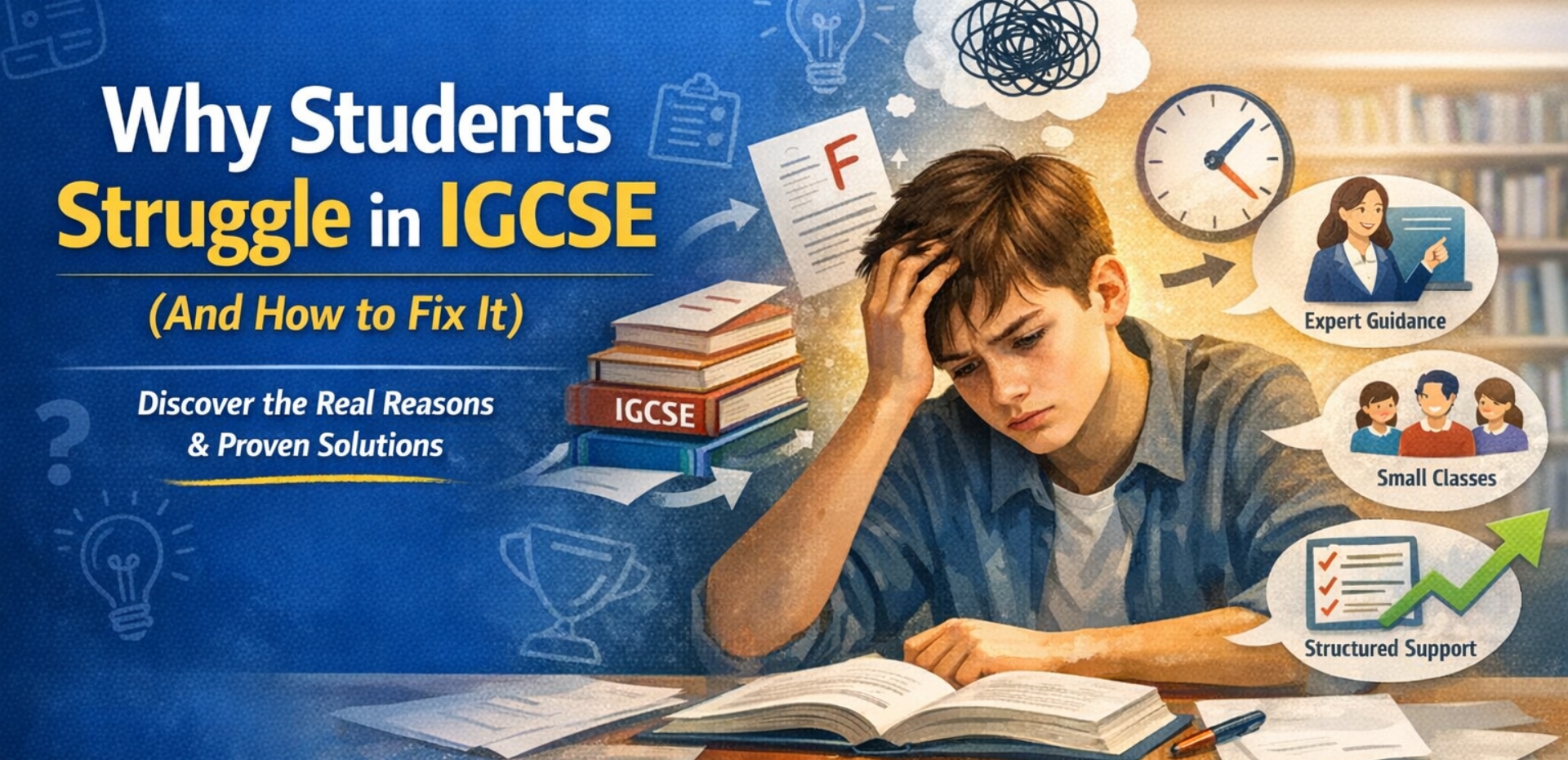
The first thing most parents think when a student begins to struggle in their IGCSEs is:
“Maybe my child isn’t smart enough.”
I can assure you, this is almost never the case.
Most IGCSE struggles do not stem from a lack of ability, but rather from a lack of structure, readiness, or the right type of academic support. What this article aims to do is explain the ‘why’ behind these ‘why’ capable students struggle in IGCSEs and how the right support system can have a drastically positive effect on student outcomes.
IGCSEs Do Not Function Like Other Exams
The first and most notable source of stress that IGCSE poses to students is that it is not simply a case of them having a more difficult syllabus, but rather it is the fact that they have fundamentally different ways of operating.
Where most education systems revolve around the idea of students memorising information, the IGCSEs expect students to:
- Understand concepts instead of just memorising them.
- Apply their knowledge to questions that they have never encountered.
- Explain the logic and reasoning behind their answers.
- And most importantly, manage their subjects all on their own.
It is reasonable for students to have a difficult time adjusting to this completely different system, especially when they have previously been successful simply through memorising.
Reason 1: Weak Foundations (That Went Unnoticed for Years)
One issue that I notice more than anything in students struggling with IGCSEs, is that there are often gaps in their knowledge of:
- Basic mathematics.
- Scientific reasoning and how to use it.
- Reading comprehension.
- Writing in an academic way.
And, of course, these gaps often go unnoticed for a number of years, often being ignored for the most part. What makes this even more concerning is that IGCSEs do not tolerate poor foundational knowledge of subjects. They expose gaps in knowledge unforgivingly.
What Fixes This:
- Diagnostically driven teaching
- Structured foundation or bridging programmes
- Targeted reinforcement before exam pressure begins
Reason 2: Skipping the “Preparation Stage”
One of the biggest mistakes parents make is rushing students straight into IGCSE.
Without:
- Lower Secondary preparation
- Concept reinforcement
- Study skill development
- Students feel overwhelmed almost immediately.
What Fixes This:
- Gradual, stepped, academic progression
- Preparation programmes before full IGCSE
- Pacing, prioritising, readiness over age
Reason 3: Ineffective Study Techniques (Not Lack of Effort)
Many of the students who are struggling, are actually working very hard, just in the wrong way.
Common ineffective habits include:
- Memorising model answers
- Doing past-year papers way too early
- Studying without feedback
- Revising without understanding mistakes
- Lack of effective strategy leads to frustration.
What Fixes This:
- Teaching students how to study, and not just what to study
- Guided analysis of past-year papers
- Ongoing feedback and correction
Reason 4: Large Classes & Teaching to the Middle
In large classes, teachers must move at a fixed pace.
This means:
- Fast learners may disengage and be unstimulated
- Slower learners fall behind and go unnoticed
- Missing questions and dialogue
- Unaddressed weak topics
- Oftentimes, tiny misunderstandings evolve into gaping holes in knowledge.
What fixes this:
- Dedicated class activities
- Dedicated time slots in the class
- Staff or tutors that provide individualised feedback
Reason 5: No Slated Assessment or Feedback
Students can go months without feedback or without any idea they are falling behind.
Things go south:
- Progress is invisible
- Low performance is only discovered too late
- Confidence is lost
What fixes this:
- Scheduled internal assessments
- Visible tracking performance
- Feedback after each test
Reason 6: Emotional stress and loss of confidence
The moment a student thinks they are “bad at IGCSE,” performance drops.
This can lead to:
- Stress of the exams
- Skipping the hard classes
- Fear of the tests
- Burnout
Stress is the issue, not the syllabus.
What solves this:
- A positive atmosphere
- Stepping up to trendy exam questions
- Confidence through gradual improvement
Why “More Tuition” Doesn’t Always Solve the Problem
A lot of parents have noticed these patterns and answer the problems by increasing:
- Time in class
- Extra tuition
- Number of subjects
Unfortunately, increasing the volume of the wrong method just raises the pressure.
IGCSE success relies on:
- Order
- Planning
- Timing
- The quality of the support
- Not the quantity.
What the “Right Support” Actually Looks Like
The right support system for IGCSE includes:
- Academic assessment before placement
- Learning in a structured way
- Specialist tutors in each subject, not general ones
- Smaller class sizes
- Ongoing assessments and constructive feedback
- Training for exams
- Support emotionally and in confidence
With all the above present, students tend to:
- Catch up faster than anticipated
- Rebuild confidence
- Perform at better levels and with reduced stress
A Hard Truth Parents Should Know
Most IGCSE students struggling to perform are not weak students. They are:
- Insufficiently prepared
- Inappropriately placed
- Unsupported
When these problems are tackled, the improvements are significant.
Final Thoughts: Struggling Is a Signal, Not a Verdict
Struggling in IGCSE is not a sign of failure. It is a sign.
A sign that something in the learning structure is not working and needs improvement.
With the right support and structure, many students who are struggling go on to:
- Pass with confidence
- Significantly improve their grades
- Relish in the learning process
The most significant aspect is the need for early action, not waiting until the exam pressure is at its peak.