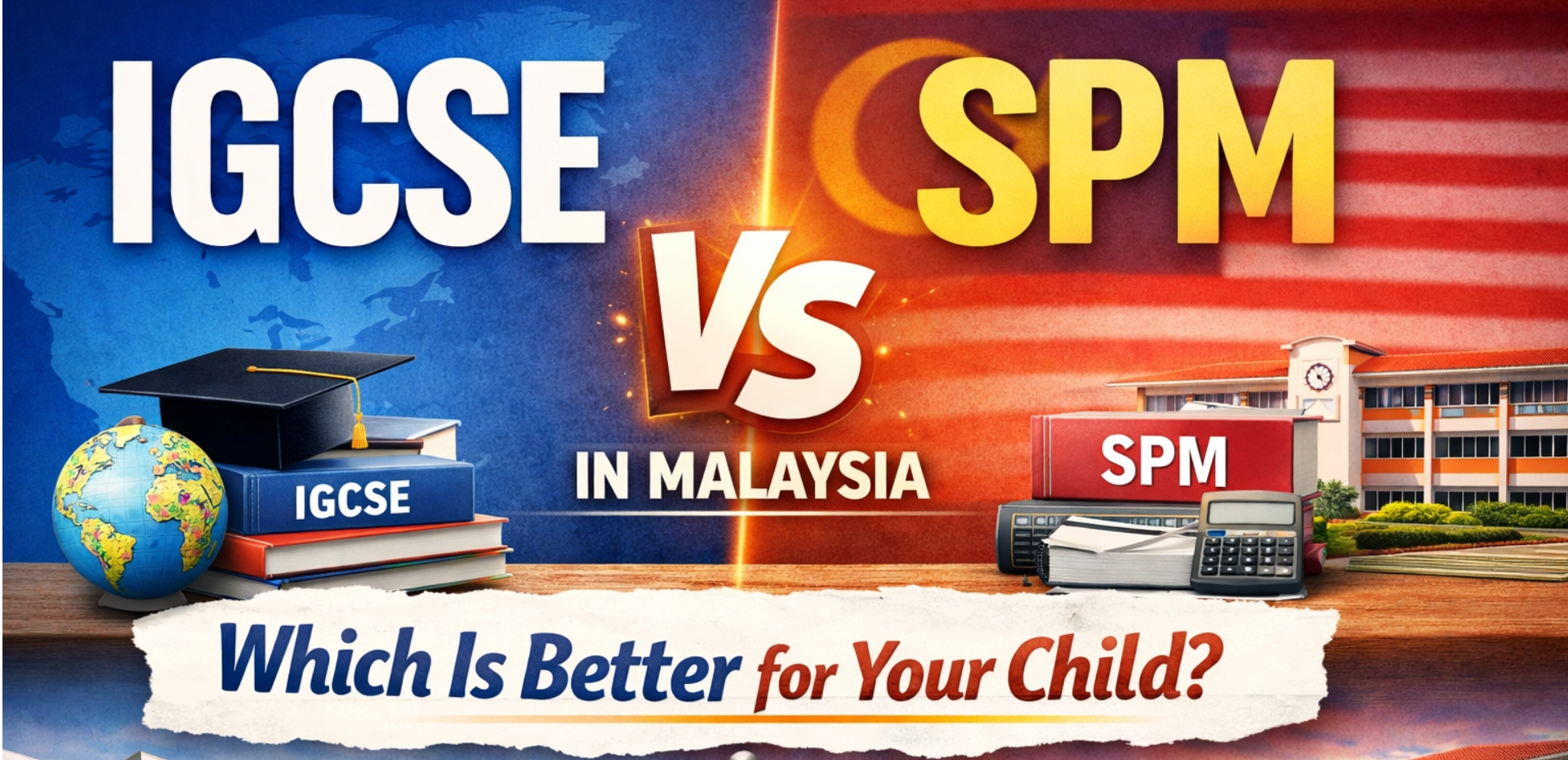
IGCSE vs SPM in Malaysia: Which Path Should Your Form 3 Child Choose?
1. Introduction: The “Crossroads” Moment
Form 3 used to end with PT3. Now PT3 is gone — but the pressure? Still very much alive.
At this crossroads, Malaysian parents are asking a sharper question:
“Is the national syllabus enough for my child’s global ambitions?”
Let’s define the contenders clearly.
SPM (Sijil Pelajaran Malaysia) is Malaysia’s national examination. It is rooted in national identity, history, and civic responsibility — and remains the backbone of public university admissions and civil service careers.
IGCSE (International General Certificate of Secondary Education) is the world’s most widely recognised international qualification for students aged 14–16. Offered in over 140 countries, it’s designed as a global academic benchmark.
The thesis is simple:
SPM is excellent for local public-sector pathways.
IGCSE, on the other hand, functions as a passport — opening doors to global universities and encouraging deeper understanding over memorisation.
2. Curriculum & Subjects: Rigidity vs. Flexibility
SPM: The “Set Menu”
SPM operates within a streaming system — Science or Arts — which, although evolving, remains relatively rigid in practice.
Students must pass Bahasa Melayu and Sejarah to receive their certificate. Most take 9–10 subjects, resulting in a heavy academic load.
The structure provides clarity. But it also limits combination choices.
IGCSE: The “Buffet”
IGCSE offers flexibility. Students typically take 5–7 subjects, selecting from over 70 options globally.
A student can combine Physics and Business Studies. Or Computer Science and Economics. These cross-disciplinary combinations are rare within SPM’s structure.
At Orient Academy Cyberjaya, subject selection isn’t dictated by quotas or timetabling constraints. Students are guided based on strengths, aptitude, and long-term career goals — not school capacity.
That difference matters.
3. Assessment Style: How Is Your Child Tested?
SPM
SPM remains heavily summative — meaning final examinations carry significant weight.
While KBAT (Higher Order Thinking Skills) has been introduced to promote analytical reasoning, rote memorisation still dominates in many classrooms.
IGCSE
IGCSE uses criterion-referenced grading. Students are assessed against a fixed international standard — not graded relative to how their classmates perform.
Assessment formats include:
- Multiple choice papers
- Structured questions
- Practical exams
- Alternative to Practical (ATP) lab papers
Marks are awarded for application and explanation — not just repeating textbook definitions.
The emphasis shifts from “What did you memorise?” to “How well do you understand?”
4. Grading Systems Compared
Aspect | SPM | IGCSE |
Scale | A+ to G (G = Fail) | A* to G (U = Ungraded) or 9–1 |
System | National standard, cohort perception influences boundaries | Globally standardised, criterion-referenced |
Paper Levels | Single | Core & Extended tiers |
There’s a persistent “bell curve” perception in SPM, where cohort performance can affect grade boundaries. IGCSE grades are standardised globally — your child is measured against an international benchmark, not just a classroom cohort.
5. University Pathways: Where Can You Go?
The SPM Route
Best suited for:
- Public Universities (IPTA)
- Matrikulasi
- Government scholarships (JPA)
Credits in BM and Sejarah are mandatory.
The IGCSE Route
Ideal for:
- Private universities (Taylor’s, Sunway, Monash)
- Overseas universities (UK, Australia, USA)
Here’s the “fast-track” secret:
IGCSE students often complete exams by age 16, allowing them to start Foundation or A-Levels earlier than their SPM peers.
Can IGCSE students enter local public universities? Yes — but it requires Bahasa Melayu (usually taken privately). Entry is more straightforward into private institutions.
6. The Language Barrier: English vs Bahasa Malaysia
SPM Science and Mathematics may be offered under DLP (Dual Language Programme), but implementation varies.
IGCSE is fully conducted in English. This naturally prepares students for IELTS and English-medium university lectures.
Concerned your child’s English isn’t strong enough?
Orient Academy’s Bridging Series (OBS) is specifically designed for students transitioning from SJK(C) or national schools. It strengthens English, Maths, and Science foundations before entering the full IGCSE syllabus.
The transition becomes strategic — not overwhelming.
7. Cost vs. Value
SPM in government schools is virtually free. But many families spend significantly on tuition centres — financially and emotionally.
IGCSE is paid education. International schools may charge RM20,000–60,000 per year.
Orient Academy offers a more focused alternative:
Small classes. Subject specialists. Exam strategy mastery.
You’re paying for academic precision — not Olympic-sized swimming pools.
- Verdict: Which One Is Right for You?
Choose SPM if:
- Your child plans to enter Malaysian civil service.
- Budget is the primary constraint.
Choose IGCSE if:
- Overseas or private university study is the goal.
- Your child struggles with memorisation but thrives in practical understanding.
- You want flexibility beyond rigid streaming.
Conclusion
Let your child experience it firsthand.
Book a Free Academic Assessment at Orient Academy Cyberjaya and discover which curriculum truly fits their learning style.
Because this decision isn’t just about exams.
It’s about trajectory.