Small Class vs Big Class: Why IGCSE Results Are Not About Intelligence
If you’re a parent of an IGCSE student, you’ve likely lived this scene.
Your child is bright. Curious. Quick with logic at the dinner table. Yet when mock exam results arrive, the grades don’t match the potential. A B where you expected an A*. A C in Additional Math despite endless tuition.
The first instinct?
“Maybe my child isn’t as intelligent as we thought.”
Let’s address the myth directly.
The Intelligence Myth in IGCSE Success
Society loves a simple narrative: A* equals high IQ. Average grades equal average ability.
But IGCSE results are rarely about raw intelligence. They’re about preparation strategy, exam technique, and the learning environment surrounding the student.
What Actually Drives IGCSE Grades?
The Cambridge and Edexcel syllabi are highly structured. Success depends on:
- Understanding examiner mark schemes
- Applying concepts precisely under timed conditions
- Mastering command words (“describe,” “evaluate,” “calculate”)
- Repeated exposure to past paper patterns
IGCSE is not a memory contest. It’s a technique game.
And technique is taught — not inherited.
A strong learning environment unlocks a student’s baseline potential. A weak one leaves it dormant.
Which brings us to the real variable: class size impact.
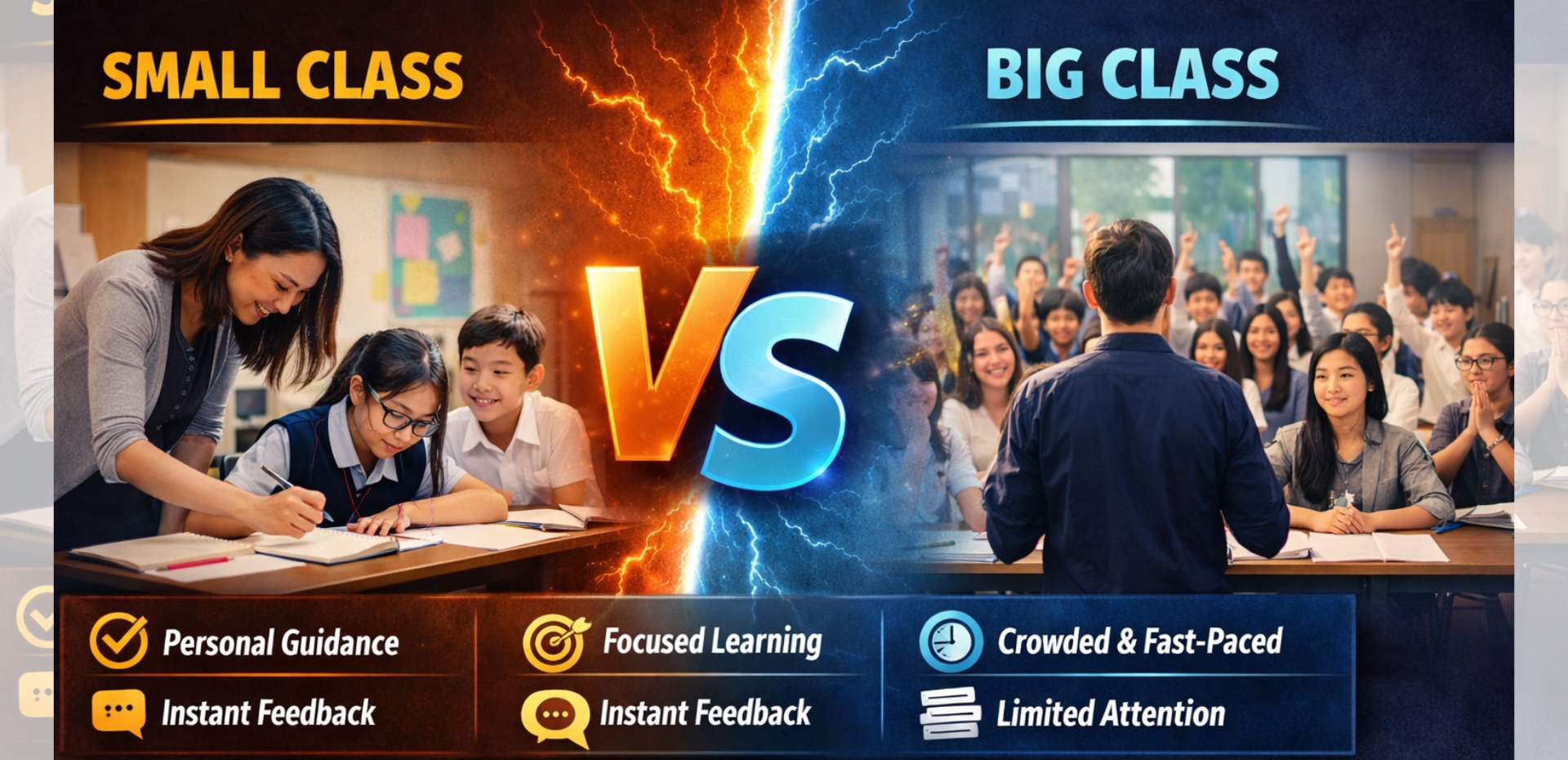
The Dynamics of a Big Class (The “Sink or Swim” Model)
A typical large classroom houses 25–30 students. In Malaysia, this ratio is common in both national and some international settings.
The Pros
Let’s be fair.
- Diverse peer interaction
- Exposure to different personalities
- Encourages early independence
Some highly self-driven students thrive in this environment.
The Cons: Large Classroom Disadvantages
But here’s where small class vs big class becomes critical for IGCSE preparation.
- Generalised Pacing
Teachers teach to the middle. Advanced students wait. Struggling students silently fall behind. - The “Hiding” Phenomenon
In a class of 30, introverted students can go weeks without asking a single question. Misconceptions compound quietly. - Slower Feedback Loops
IGCSE mastery depends on detailed past paper feedback. In large classes, marking often becomes generalised or delayed. Teachers simply do not have the bandwidth for line-by-line breakdowns for every student.
This is where many capable students plateau.
The Power of a Small Class (The “Guided Mastery” Model)
Now imagine a classroom of 8–15 students.
The dynamic shifts entirely.
Why Small Classes Supercharge IGCSE Prep
Tailored Pacing
Teachers adjust lessons in real time. If half the class struggles with trigonometric proofs, the lesson pivots immediately.
Psychological Safety
Students feel safe asking “basic” questions about Physics vectors or Additional Math integration without peer judgement. Confidence grows.
Hyper-Personalized Feedback
In small groups, teachers can dissect essays and structured answers line-by-line:
- Where did marks drop?
- Was the keyword missing?
- Did the explanation lack depth?
This level of precision dramatically improves IGCSE exam strategy.
Global meta-analyses consistently show smaller student-teacher ratios correlate with stronger academic outcomes. It’s not magic. It’s mechanics.
Small Class vs Big Class: A Head-to-Head Comparison
Feature | Large Class (25+ Students) | Small Class (8–15 Students) | Impact on IGCSE Prep |
Teacher Attention | Limited 1-on-1 time | Frequent personalised guidance | Faster correction of weak concepts |
Pacing | Rigid; average-focused | Flexible; adapts instantly | Ensures full syllabus mastery |
Marking Depth | Generalised feedback | Detailed past paper analysis | Mastery of mark schemes |
Engagement | Easy to disengage | High accountability | Reduces IGCSE stress and procrastination |
For exam-driven systems like IGCSE, the difference compounds over two years.
How to Choose the Right Environment for Your Child
Not every child needs the same structure.
Ask yourself:
- Is my child a self-starter who thrives independently?
- Or do they perform best with mentorship and accountability?
When evaluating schools or tuition centres, ask:
- What is your maximum student-teacher ratio?
- How often do students receive individualised past paper feedback?
- How do you handle exam strategy training?
The Hybrid Approach
If your child is already in a large school class, supplementing with small-group IGCSE tuition can bridge the gap.
Many high-performing students in Malaysia and Singapore follow this model: big-school exposure plus small-group strategic coaching.
It’s not about replacing the system. It’s about reinforcing it intelligently.
Conclusion: It’s the Soil, Not the Seed
A B or C in a massive class does not define intelligence. It often reflects environment.
Potential is like a seed. Intelligence is the genetic code. But growth depends on soil quality — feedback, pacing, psychological safety, and mentorship.
When parents debate small class vs big class, they’re really asking:
“Where will my child’s potential be nurtured best?”
Because in the world of IGCSE results, success isn’t about the size of the brain.
It’s about the size of the support system.
If you’re unsure whether your child’s current environment is helping or hindering their exam readiness, consider arranging a small-class trial or academic consultation.
The right environment doesn’t just improve grades.
It reveals what was already there all along.